We Research: Ageing technology skills in continuing education – network map outlines the national situation regarding education and networks
The aging of the population is one of the most significant social challenges and has a direct impact on the demand for social and health services and the need for education. As the number of older people grows, more care and support are needed, but at the same time there is a serious shortage of personnel. This highlights the need to make more effective use of technology in services for the elderly. Although the possibilities offered by technology are vast, their utilization is limited by the lack of expertise among social and health care personnel. Ageing technology skills are not yet an established part of basic training in the field, and the continuing education available is often fragmented, poorly accessible, or does not meet the practical needs of working life.

The main objective of the IkäteknosNet (AgeTechNet, Age Technology Continuous education through Multidisciplinary Networking) project is to create a strategic, national network cooperation model for continuing education in age technology in order to meet growing demand. The project includes an analysis of the current state of continuing education in age technology and networks related to age technology expertise and education provision. Based on this, cooperation on continuing education provision will be developed with stakeholders and educational institutions through workshops and interviews.
The survey mapped out the training offerings, providers, and cooperation structures in the field of continuing education
The collection of data for the network map began by mapping training providers both in the project implementers' regions and nationally. The data collection focused on a survey targeted at training providers (schools, stakeholders). The survey examined the training courses on offer and their providers, including employer staff training, forms of cooperation, the links between RDI activities and training, and the methods, scope, and learning objectives of the training courses.
The survey examined the role of educational institution networks in the development of continuous learning. This was used to identify the key actors and roles in the networks, forms of stakeholder cooperation and operating methods, and processes for identifying training needs and planning training. In addition, the role of stakeholders in educational institution cooperation was analyzed. Interviews and analysis were used to identify key stakeholder networks and their actors, the main tasks, objectives, and operating models of the networks, and their links to the overall concept of continuous learning.
SAMK was responsible for mapping the activities of stakeholders, and here are a few observations. It is important to note that the results of the analyzed material are based solely on information provided by the organizations, associations, and companies that responded to the survey and therefore do not necessarily provide a comprehensive picture of the situation in the entire field.
The organizations have an extensive and active cooperation network, which includes universities, welfare sectors, municipalities, technology companies, volunteers, and other organizations. Through cooperation, the organizations promote the use of age technology, particularly through pilot projects, the collection of user experiences, and joint campaigns. In libraries, age technology has not yet become an established part of the service offering. Digital support mainly focuses on guidance on basic equipment, and there have been very few technology-focused surveys. Cooperation between libraries is limited, with only a few cooperating with educational institutions and none cooperating with technology companies.
From the perspective of technology companies, higher education institutions are clearly the most common partners. Welfare sectors, vocational education institutions, and organizations are also actively involved in cooperation. On the other hand, the role of volunteers, the elderly, and municipalities in cooperation has been minor so far. Cooperation between actors in the welfare sector (HVA) and networks is variable and often less frequent. The exception to this are schools, with which there is a great deal of cooperation. Around half of the welfare sector operators responded cooperate with municipalities, cities, and organizations. There are numerous pilot projects and trials, and feedback is actively collected. Otherwise, however, little user feedback is collected. Information exchange has been identified as a clear area for development. The most common role in networks is an expert, and networks meet several times a year.
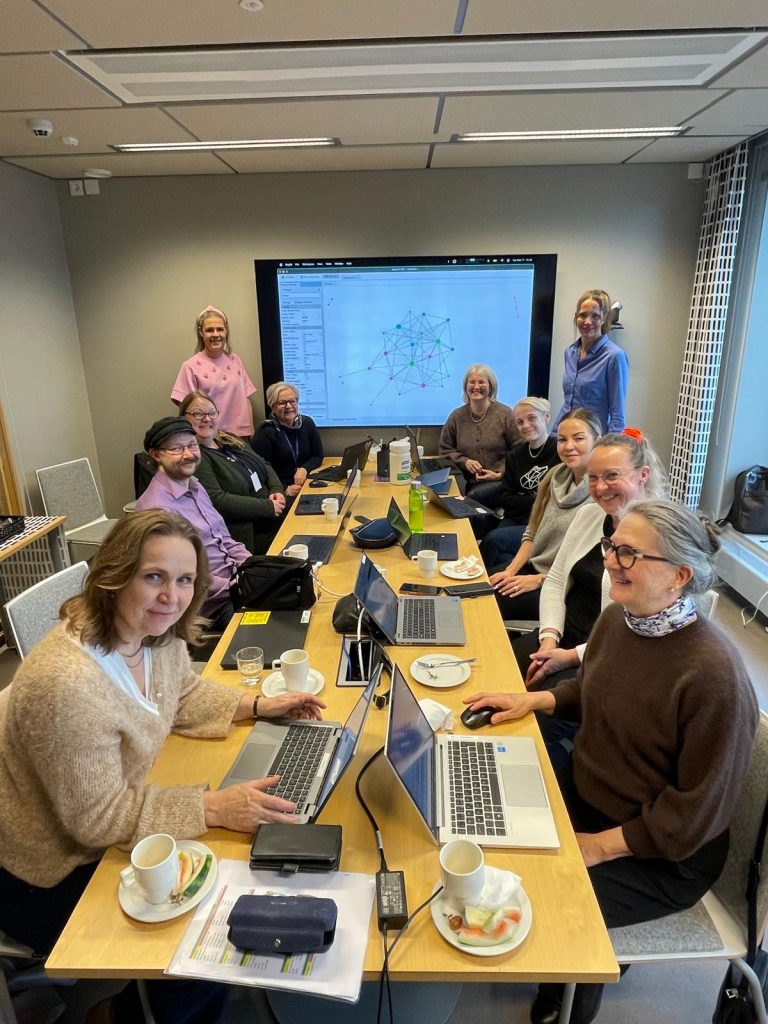
The material obtained was analyzed and processed into a network map using the Gephi tool. The network map shows the overall range of continuing education courses, the providers and implementation methods, as well as the networks of educational institutions and stakeholders and their cooperation structures. It can also be used as a tool for developing education and strengthening cooperation nationwide.
Did you know?
- The aim of the network mapping is to form an overall picture of the continuing education offerings related to age technology and their use at the national level
- Based on the results of the mapping, cooperation with stakeholders and educational institutions on continuing education offerings will be strengthened, utilizing workshops and interviews as development tools.
- To develop continuing education offerings in the field of age technology to better meet the needs of the social and health care sector
- The result will be a national network cooperation model that brings together operators offering continuing education in the field of age technology. The model will enable learning independent of time and place, which is directly applicable to the needs of working life in the social and health care sector.
- The aim is to strengthen expertise, promote the accessibility of training, and support the technological readiness of professionals in the field in their practical work.
Age Technology Continuous education through Multidisciplinary Networking - AgeTechNet is a group project funded by the European Social Fund Plus (ESF+), with Metropolia University of Applied Sciences as the main implementer. The sub-projects are implemented by TAMK, Winnova, OAMK and SAMK.