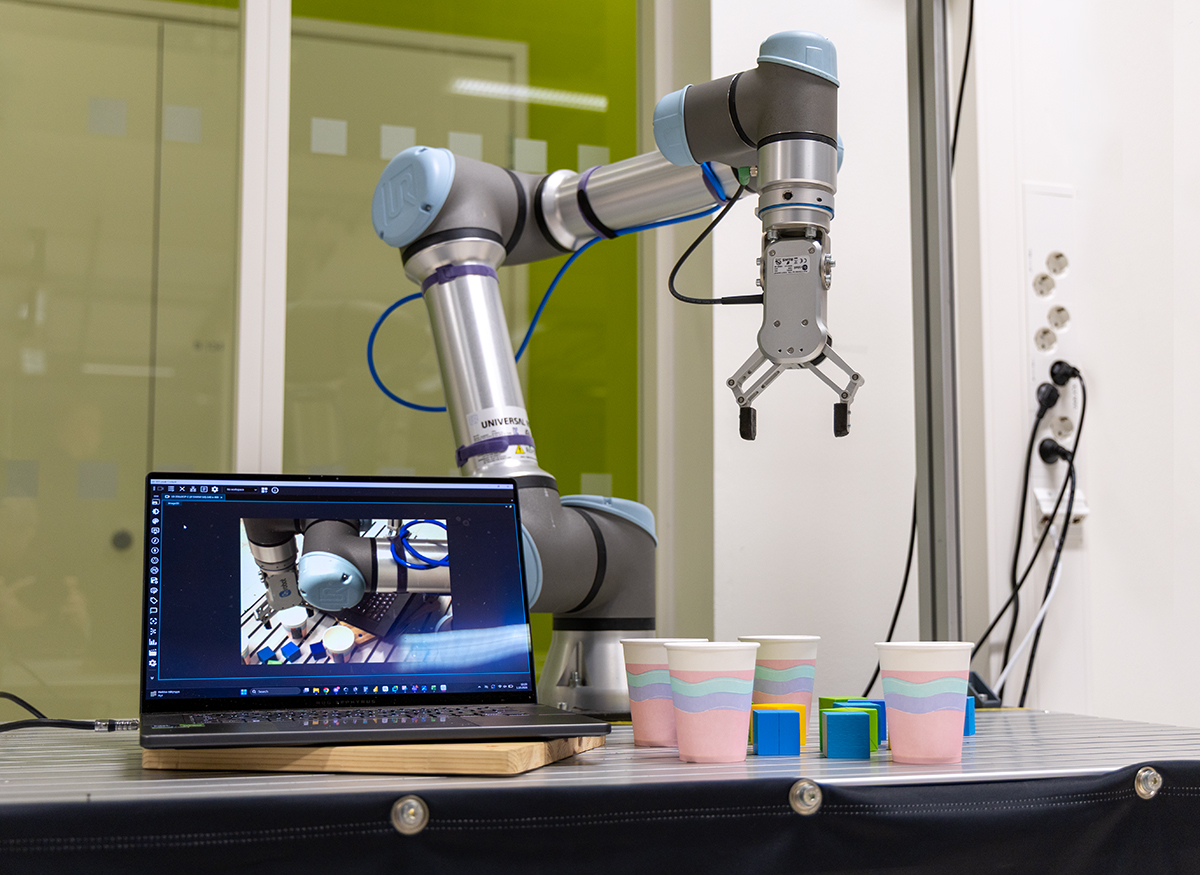
At the RoboAI Research Center, researchers are developing cognitive robotics solutions in which robots do more than simply perform pre-programmed movements: they can also learn new tasks, for example from demonstrations provided by humans. One concrete outcome of this work is a robotics research dataset collected at RoboAI, which is now openly available for anyone to use.
In traditional robotics, a robot’s tasks and movements are largely defined in advance. In cognitive robotics, the aim is for robots to make use of information from their environment and adapt their actions accordingly. In addition to new learning methods, this requires high-quality data that can be used to train and develop AI models.
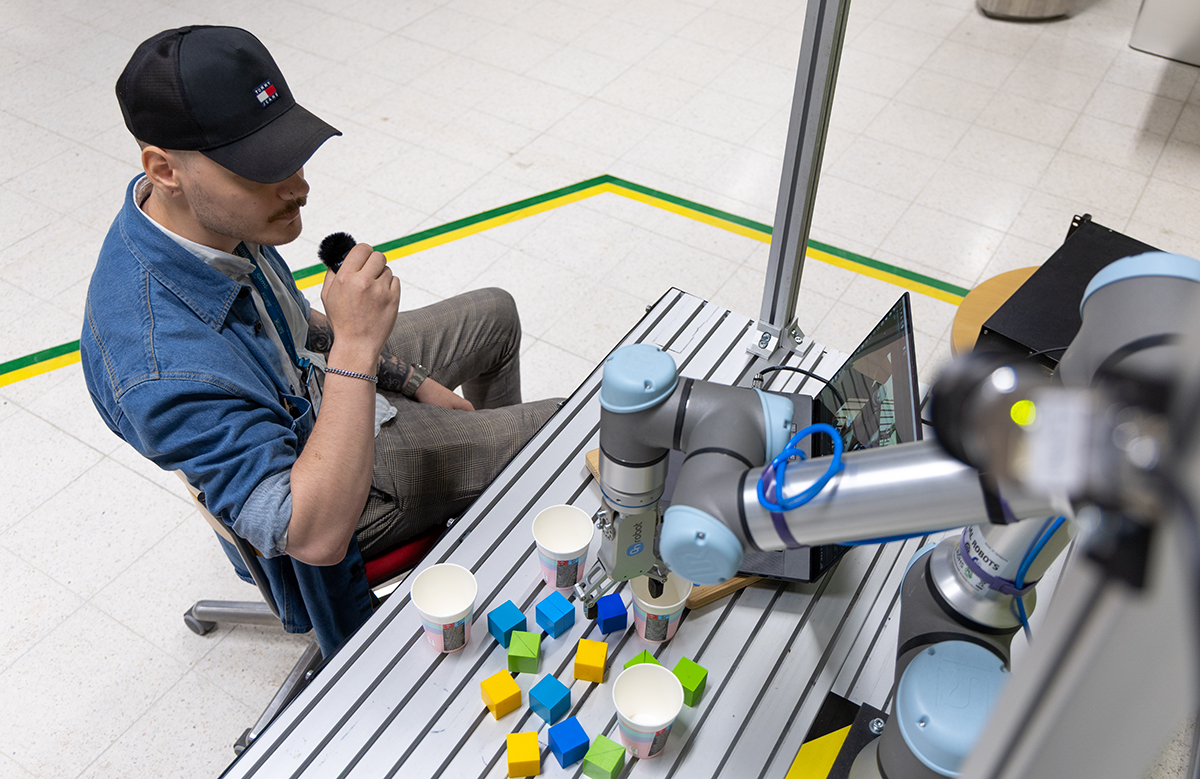
Hundreds of training episodes formed an open dataset
At the RoboAI Research Center, a cognitive robotic system combining a UR5e robot with a machine vision system was designed and implemented. The system was used to record 443 training episodes in which the robot manipulates objects detected by the machine vision system based on instructions given to it via chat.
– One training episode covers a complete task performed by the robot from start to finish. During each episode, we recorded synchronised camera images, robot state data and text-based instruction describing the task, explains Joonas Rouhiainen, researcher responsible for designing and collecting the dataset.
The dataset has now been published in TensorFlow Datasets catalogue developed by Google. This makes it openly available to researchers and developers and enables its use in the research and development of AI models for robot learning.
– Anyone can freely use the dataset either on its own or together with other robotics datasets, for example to train robot control models, Rouhiainen adds.
From the laboratory towards a real-world operating environment
The dataset is a part of the CoRI5.0 cognitive robotics project, which explores robot learning, machine vision, human–robot collaboration, and new ways of programming robots. So far, the project has investigated different algorithms and methods and demonstrated the potential of cognitive robotics. The next step is to apply this knowledge to an intralogistics pilot carried out in cooperation with Cimcorp Oy.
– Our aim during the autumn is to build a demonstration that works in laboratory conditions. Next year, the solution will be tested in a real-world operating environment, says Kari Marttila, Project Manager of the CoRI5.0 project.
Towards more flexible robotics
As teaching new tasks becomes easier, robots could in future be used more flexibly in environments where products, tasks and conditions are constantly changing.
– This is not only about teaching an individual robot, but more broadly about how robotics could adapt more effectively to changing needs in the future. The aim is that robots could eventually be guided by people who do not know how to programme them using traditional methods, summarises Mirka Leino, Principal Researcher.
Interested in the topic? Watch the video
The video demonstrates cognitive robotics research in practice. It shows how a neural network model uses a natural-language instruction and camera image to control the robot’s actions in real time.
The CoRI5.0 – Cognitive Robotics Initiative for Industry 5.0 project is implemented by Centria University of Applied Sciences, Satakunta University of Applied Sciences, Turku University of Applied Sciences and Vaasa University of Applied Sciences. The project is funded by the European Regional Development Fund (ERDF), the Economic Development Centre of Eastern Finland and the participating companies.